

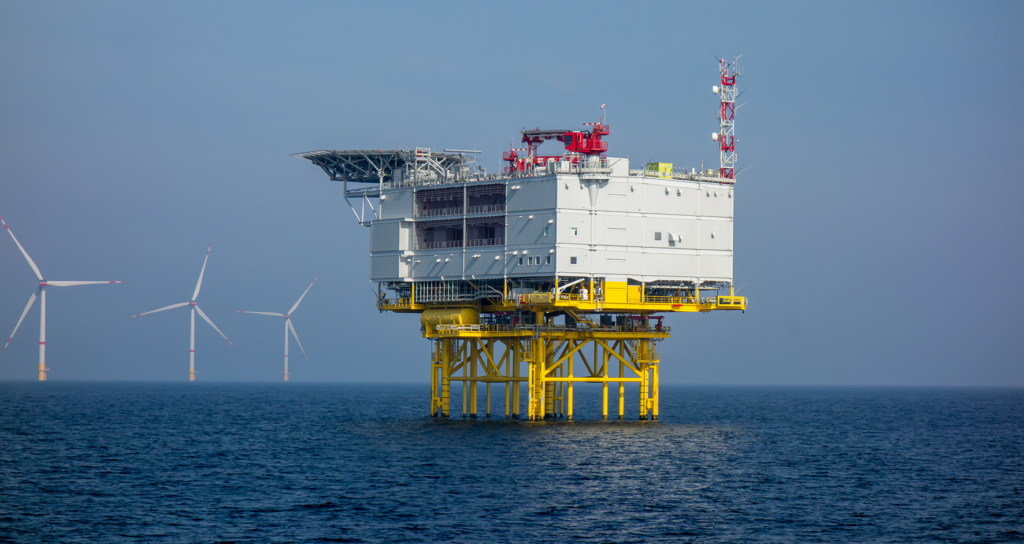

Offshore wind has become central to Europe’s clean energy transition. Across the North Sea, capacity is expanding rapidly as governments accelerate decarbonisation and strengthen energy security. Yet behind every gigawatt of renewable generation lies a layer of complex, high-risk infrastructure that must function flawlessly if electricity is to reach homes and industries onshore.
Central to that effort is a 2-gigawatt high-voltage direct current (HVDC) offshore transmission system, forming part of a major North Sea grid expansion for one of the Netherlands’ largest transmission operators. Designed to convert electricity generated at sea and transmit it efficiently to the mainland grid, the offshore converter platform is among the largest of its kind ever undertaken.
Engaged by a premier Singapore-based EPC contractor and global leader in offshore, marine and energy engineering solutions, TBH’s Singapore team supported the delivery of the platform – its critical planning carried out thousands of kilometres from European waters.
Planning one of Europe’s largest offshore energy structures
At the heart of the project is an offshore converter platform of extraordinary scale. Comparable in footprint to a football field and rising close to ten storeys high, it integrates heavy structural fabrication with highly specialised electrical systems, all delivered through tightly sequenced offshore installation and commissioning works. Each stage relies on the precise coordination of multiple contractors, global supply chains and long-lead equipment.
The project also sits within a broader framework of HVDC developments delivered in overlapping phases. As earlier platforms progressed through construction, the project moved into planning. Engineering design, procurement and fabrication advanced in parallel, with decisions in one area having immediate impact elsewhere. In this environment, planning assumptions are tested continuously and the margin for error narrows quickly.
“By the time the project moved into detailed planning, multiple workstreams were already progressing,” said Meiske Sompie, Director, Asia. “Design was still evolving, procurement decisions were advancing, and earlier platforms were setting precedents that needed to be reflected. Our role was to help the team translate that complexity into a delivery baseline that could support informed decision-making.”
Why Singapore matters to offshore wind
The leadership of this work from Singapore reflects the country’s growing role in the global offshore wind industry. Singapore does not currently deploy large-scale offshore wind farms for domestic power generation, constrained by geography and wind conditions. Yet it has become
an important centre for offshore engineering and delivery, supporting major energy infrastructure projects worldwide.
Singapore is also pursuing renewable energy imports as part of its long-term low-carbon strategy, while participating in research and innovation collaborations that support offshore renewable technologies. Together, these efforts reflect a pragmatic approach to the energy transition, combining domestic capability with cross-border integration.
Within this environment, TBH’s Singapore office has developed extensive expertise supporting complex offshore and energy programmes, working alongside engineering and construction partners to manage delivery risk as projects scale in size and ambition. That experience across offshore platforms, subsea works and large-scale energy infrastructure was a key factor in its selection to support project execution, where success depended on aligning multiple workstreams within a demanding delivery framework.
“Offshore HVDC platforms are among the most complex structures delivered in the marine environment,” said the Portfolio Project Controls Manager on the programme. “Successful delivery relies on disciplined engineering, close coordination across the supply chain and clear execution planning. On this project, TBH played a key role in the development of the baseline programme, helping to align multiple workstreams within a highly constrained delivery environment.”
For TBH, the engagement reflects a broader role in supporting clients through complex, capital intensive infrastructure – bringing structure to delivery planning and an independent perspective to enable confident, well-informed decisions across some of the energy transition’s most demanding portfolios.